
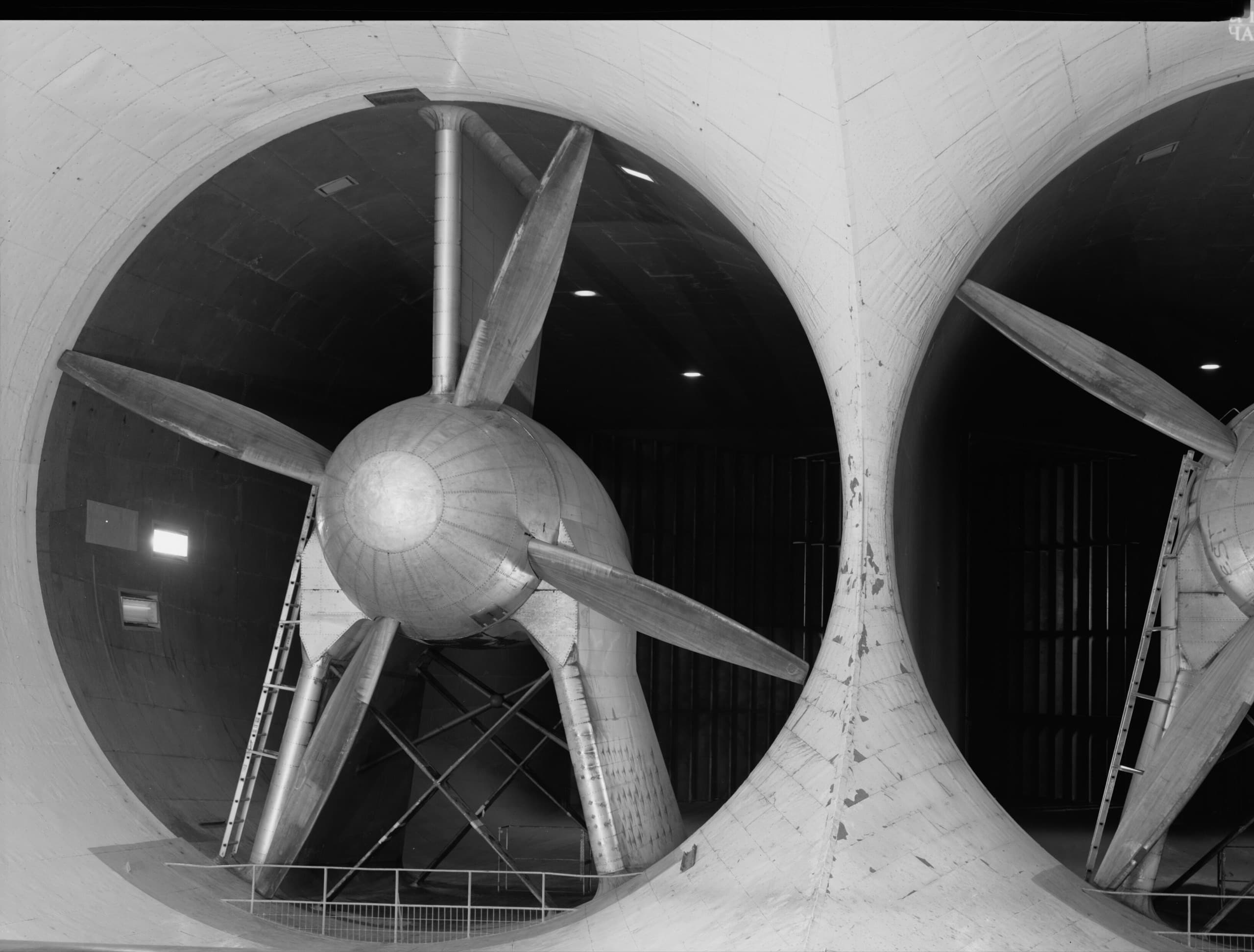
Nobody has ever scheduled abreakthrough.
- $202B
- spent on United States federal R&D each year
- 25
- federal agencies funding it
- 0
- layers connecting any of it
Darwin found natural selection in an essay about population economics. A radar engineer noticed his magnetron was heating food and the microwave oven followed. The first airplane was built by two men who repaired bicycles and thought of flight as a balance problem.
Nobody planned any of them. They are three of the twenty entries below, from the 1440s to 1998.
The record
Twenty times a field solved another field’s problem by accident.
Nobody scheduled any of these. Every entry in the last column is some version of by chance.
05 / 20
| 1440s | The printing press | The screw press, used for wine, oil and paper | A screw frame that presses evenly across a whole flat surface at once | A press was built for Gutenberg in Strasbourg by 1439; the movable type was his own |
| 1608 | The telescope | Spectacle-lens grinding in Middelburg | A convex objective paired with a concave eyepiece | Lippershey filed in October 1608; Galileo heard the description and built his own in months |
| 1665 | The cell, and the word for it | Optical instrument making | Two-lens magnification, turned on a shaving of cork | Hooke used a microscope built for him by Christopher Cock, and named what he saw after monks' rooms |
| 1796 | Vaccination | Dairy farming folklore about milkmaids | Deliberate cowpox infection to buy immunity to smallpox | The folklore was already circulating and Benjamin Jesty had acted on it in 1774; Jenner ran the challenge test |
| 1816 | The stethoscope | An acoustic trick Laennec remembered | A tube as a sound conduit, replacing an ear pressed to the chest | He rolled up a sheet of paper to examine a patient in Paris, and published the method in 1819 |
| 1838 | Natural selection | Malthus on population economics | Population outruns resources, so variation is sorted rather than preserved | Darwin read it ‘for amusement’ in October 1838; Wallace reached the same place independently in 1858 |
| 1856 | The synthetic dye industry | A failed attempt to synthesise quinine | Oxidised coal-tar aniline, impure, throwing a fast purple | Perkin was 18, working in a home lab over Easter on an antimalarial that was not chemically possible yet |
| 1895 | Medical radiography | Cathode-ray tube physics | Rays that pass through soft tissue and stop at bone | He shielded a Crookes tube and a screen across the room still glowed; surgeons used it within weeks |
| 1903 | Powered flight | The bicycle trade | Flight as a balance problem the pilot works, not a stability problem | Rivals chased self-righting machines; the Wrights built something a trained rider had to fly |
| 1912 | Continental drift | Meteorology and palaeoclimate fieldwork | Glacial and tropical deposits, in the wrong climate belts | Wegener was not a geologist, and geologists dismissed him for it, and for having no mechanism |
| 1928 | Penicillin | The mycology lab one floor below | A mould that killed bacteria, on a plate meant for bacteriology | La Touche grew moulds downstairs and identified Fleming’s contaminant |
| 1938 | Teflon | Refrigerant chemistry at DuPont | A gas that had polymerised itself into a solid nobody was looking for | Plunkett opened a cylinder that gave no gas on 6 April 1938 and cut it open to find white powder |
| 1945 | The microwave oven | Radar magnetrons | Microwaves depositing energy directly into the water in food | Spencer noticed a live magnetron at Raytheon was heating things nearby, then tested popcorn on purpose |
| 1948 | Information theory | Statistical mechanics | Boltzmann and Gibbs entropy, reused as a measure of uncertainty in a message | Shannon found that the formula for disorder in a gas already described how much a signal could carry |
| 1953 | The structure of DNA | X-ray crystallography, a physics technique | Reading a diffraction pattern back into the shape that produced it | Gosling and Franklin made Photo 51 at King’s; it reached Watson through Wilkins, without her knowledge |
| 1955 | Velcro | Burdock burrs, a seed-dispersal mechanism | Stiff hooks catching soft loops, releasing under load and re-fastening | De Mestral put a burr under a microscope after a 1941 hunting trip; the loom took until 1959 |
| 1955 | Medical ultrasound | An industrial detector for flaws in boiler welds | Pulse-echo timing, used to tell one kind of tissue from another | Donald borrowed a Kelvin and Hughes detector at a Renfrew boilermaker and tested tumours against steak |
| 1965 | The Big Bang, confirmed | Satellite-communications engineering | Antenna noise that would not go away, read as a signal rather than a fault | Penzias and Wilson ruled out the pigeons; Burke connected them to Dicke’s group, who knew what it was |
| 1983 | Simulated annealing | Metallurgy | Cost becomes energy, randomness becomes temperature | Kirkpatrick, Gelatt and Vecchi ran the Metropolis algorithm on circuit layout and published it in Science |
| 1998 | PageRank | Bibliometrics, and counting citations | An inbound link read as a citation, so authority accrues | Brin and Page framed the web as a citation graph; Kleinberg and Li reached related ideas at the same time |
- 54%
- of Nobel-winning science discoveries came from researchers already holding degrees in two or more fields. For major discoveries that did not win, 42%.Krauss, 2024
- 84%
- of physiology and medicine laureates had combined two or more developed interests inside their own field. Peace laureates, the lowest, 54%.Root-Bernstein, 2022
What we did about it
So we built it.
We index research by the shape of the problem. We ran fifty documented historical transfers through the engine on 2 and 3 September 2026, and a leading AI search through the same problem statements. The engine reached the field that had solved the problem in 21 of the 50 cases, and that search reached it in 3. Of the 43 cases whose source paper we could ingest, the engine returned that paper 10 times, 7 inside the top twenty, and that search returned it zero times.
- Deterministic
- The same problem returns the same matches. Nothing is regenerated on each run.
- Auditable
- Every claim carries the passage it came from, checked by code rather than by a model.
- Domain blind
- No field filter is applied before ranking, and distance is reported rather than used to exclude.
Methodology
What gets indexed
Both of these exist to keep a field's vocabulary out of the index.
Reduce the problem to its cause
Every mechanism is stripped to what is physically happening, under what conditions, and how it goes wrong. That is the unit we index.
Match structure against structure
The reduced form is matched against every other reduced form we hold, in every domain. The radar engineer and the biologist never learn each other's language.
Six things that follow once a mechanism is in the index.

Findings that cross an agency line
The United States spends around $202 billion a year on research across more than 25 federal agencies. The engine moves a finding across a domain boundary without anyone requesting it.

The same physics, indexed once
Every mechanism is fingerprinted by its causal structure rather than its vocabulary, so the same physics in a defense lab and a biology lab resolve to the same fingerprint without anyone noticing the resemblance.

A map of how things fail
Deduplicated, written in language that belongs to no field, growing with every paper we read. 113,394 papers are abstracted and indexed.

Your open problem, closed elsewhere
A radar engineer's open problem may already be closed in cell biology. In 43 documented transfers, the answer waited a median of 13 years.

Work that stays behind the firewall
Classified and proprietary problems never leave the silo. Only the abstract causal signature travels. The application, the context and the data stay where they are.

The crossings nobody has made
The engine knows which structures are connected and which are not.
The plan
The last stage is a lab that takes its problems from the engine.
Each stage pays for the next one. None of them needs a raise to start.
The work
Somebody pays us to run one problem through the engine. That fee is the only revenue in the company.
Atlas
Atlas
The same engine, run by the researcher. Today atlas.darksigmalabs.com is a waitlist page.
the bench
The bench
Machine shops and labs across Central California sit idle most of the week. We standardise them, so a transfer the engine found can be built and measured.
the lab
The lab
A wet lab of our own, working only on transfers the engine found and the bench proved buildable.